
Liquid honey
Adjust pumping speed and the end of filling to suit the flow behaviour.
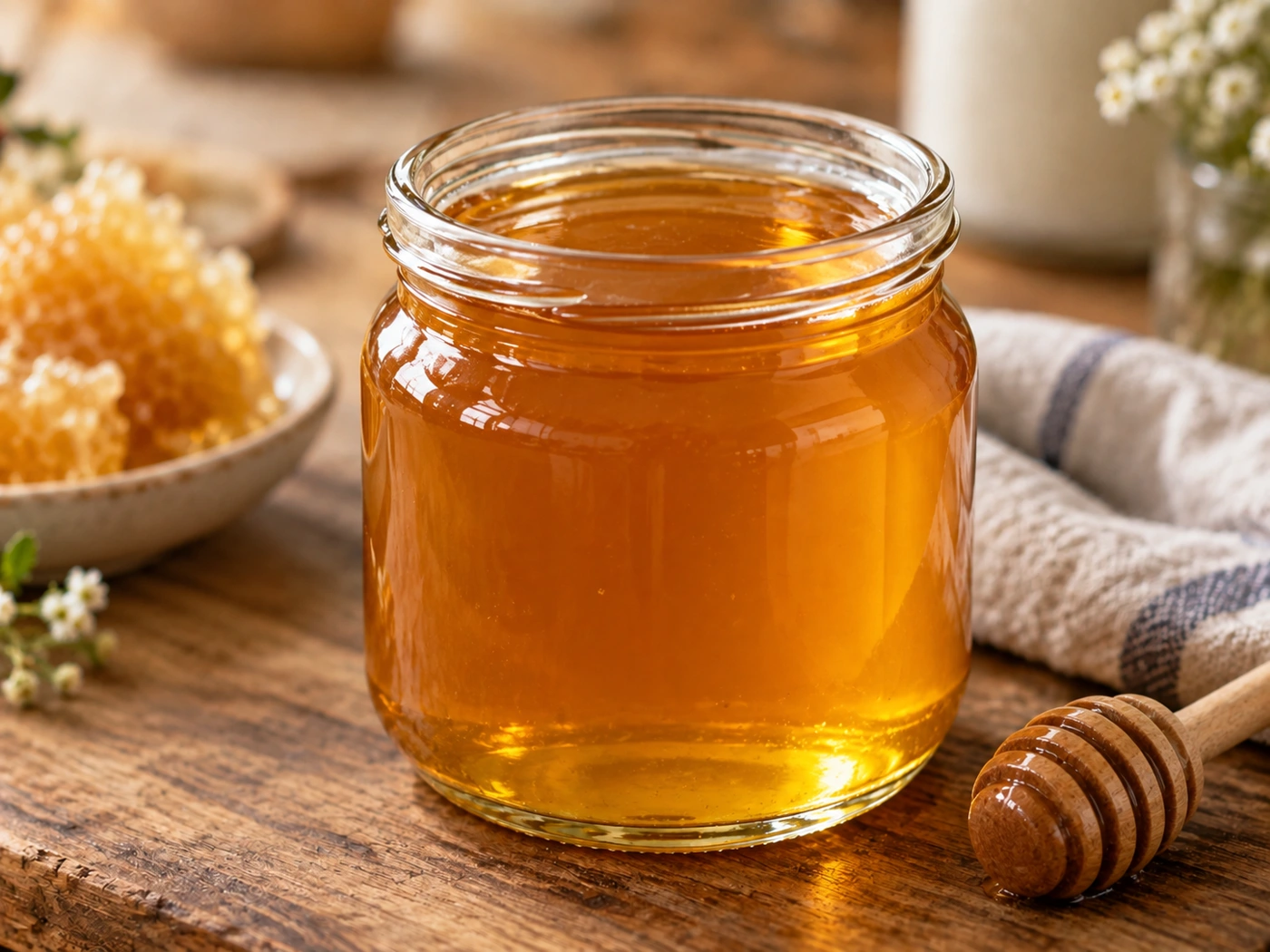
Filling honey
Liquid or creamed honey: the FMZ filling machine combines a gear pump with adjustable pumping speed, actual-weight calibration and suck-back.
ILLUSTRATIVE IMAGE
For your honey
Liquid and creamed honey flow differently. Match pumping speed, calibration and the end of filling to your prepared honey. A hopper and rotary table extend the setup to suit your batch size and working method.
What matters for your product
Adjust pumping speed and the end of filling to suit the flow behaviour.
Honey that is already creamed and pumpable can be dosed. Filling does not replace creaming.
Temperature and crystallisation affect pumpability. Heavily crystallised or very cold honey needs suitable preparation.
Fill using the selected quantity.
Determine the actual fill weight.
Enter the measured weight on the touchscreen.
The controller calculates the correction.
Schematic process · External scale · Symbolic display illustration
Actual weight is determined with an external scale. There is no built-in weighing system.
Matched to production
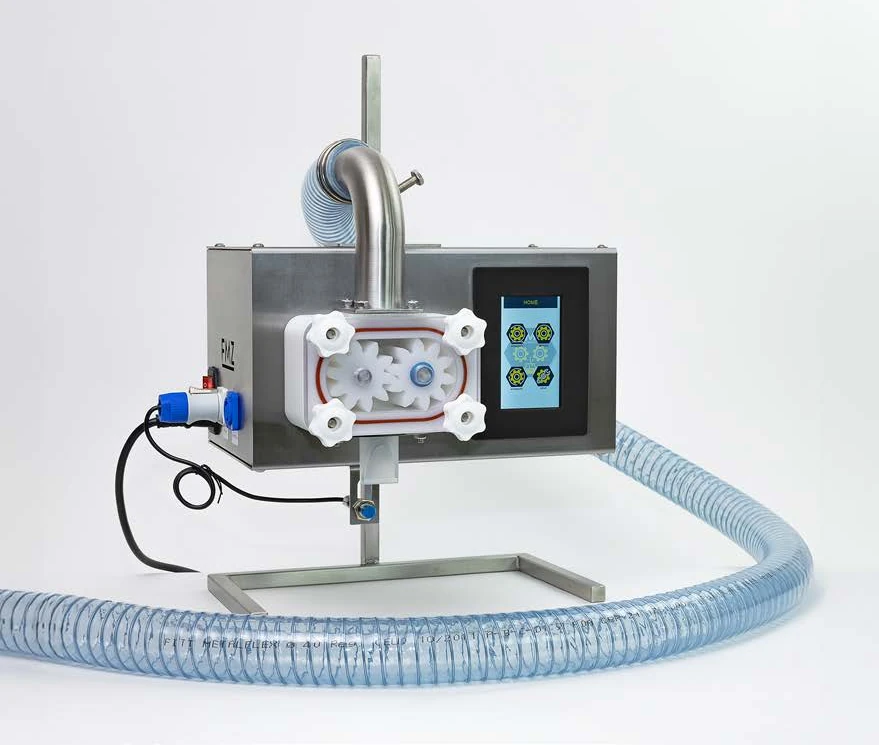
Dose suitable viscous foods. Set the fill quantity and calibrate using actual weight.
Explore the filling machine
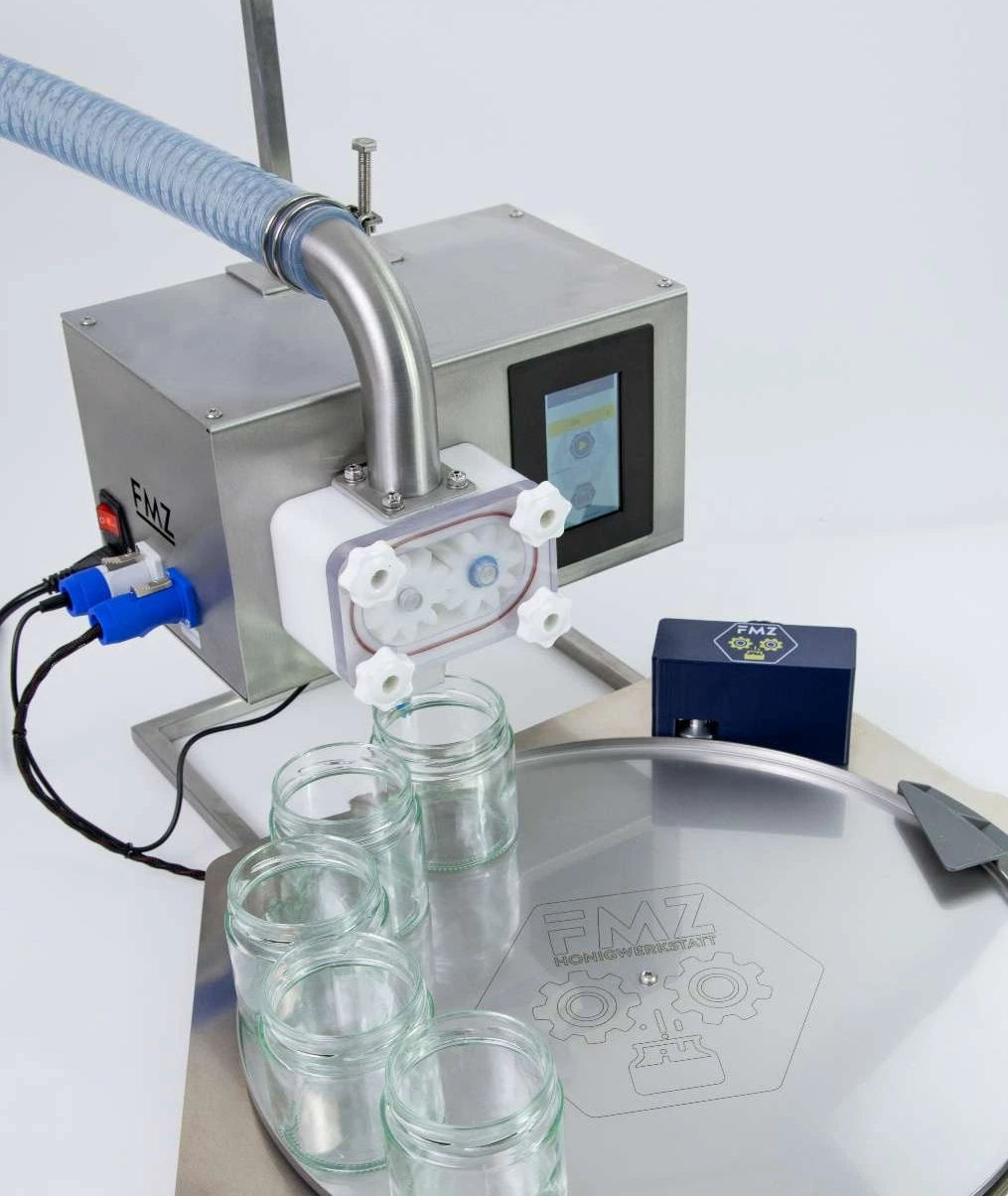
DT45 for the worktop or DT80 as a mobile unit. Controlled by the FMZ filling machine.
Compare DT45 and DT80Shown: DT45 with filling machine.
Liquid honey and already creamed honey feed differently. Assess your honey at the temperature at which you actually fill it. A cold-stored bucket may behave differently from the previous batch. If product flow stalls, a higher pump speed is not automatically the answer. First check product condition, container position and hose routing.
Keep the suction hose as short as possible and free of kinks. The intake opening must remain in the product and must not suck against the container bottom or wall. The operating instructions recommend placing the honey container above the machine where possible. Fill and vent the pump head as instructed before setting up dosing. Visible air in the hose is a reason to check the feed.
For small batches, direct feed through the hopper can simplify setup. Use the suction hose when feeding from a supply container. What matters is whether your honey flows reliably to the pump head. The hopper is a feed device, not a mixer: already creamed honey is dosed; its creamy structure is not created in the machine.
The FMZ filling machine doses with a gear pump. It does not weigh the contents of the jar during filling. The set weight is matched to the dosing process using a weighed test fill. Tare the empty jar on your external scale and enter the actual net weight of the test fill. Then check the next fill.
Check weight during setup, after changing speed or fill quantity, and when product conditions change. Do not use settings from another batch without checking them. A series of weighed test fills shows whether there is a consistent deviation or varying results. Variation cannot simply be assessed through a one-off weight correction; the feed must also be checked.
Adjustable suck-back moves product back after filling. Together with a suitable, clean filling valve, it can reduce dripping. Check the end of filling with your honey and settings. Do not compensate for a damaged or dirty valve by continually increasing suck-back.
Without a rotary table, you position and remove each jar directly at the filling point. On the DT45, you align empty jars manually at the outer rim. On the DT80, a jar guide moves jars outwards. In each case, the filling machine controls feeding, stopping and dosing. Removing filled jars, replenishing honey and supervising operation remain your tasks.
Consider the whole job: setup, product feed, test fill, ongoing filling, removal and cleaning. An hourly output from a reference application does not automatically describe your batch. Small jars, frequent product changes or slow-flowing consistency can change the process. Batch size, jar dimensions and available worktop space help with selection.
Your application
For honey, approx. 450 jars of 500 g per hour is a stated practical reference figure. Temperature, viscosity and workflow affect the output achievable.